How to Choose AI SEO Tools for AI Overview Optimization: Buyer's Guide
AI Overviews name two or three brands per answer, and ranking first no longer guarantees you are one of them. That gap between a Google position and an actual AI mention is now a buying decision, and the tools claiming to close it are not equal.
This guide gives you the criteria to separate real AI Overview optimization tools from hype, then applies them to Rankera. By the end you will know what to check, what AI visibility costs, and whether Rankera fits your brand.
What Is Rankera? A Done-For-You AI Visibility Service
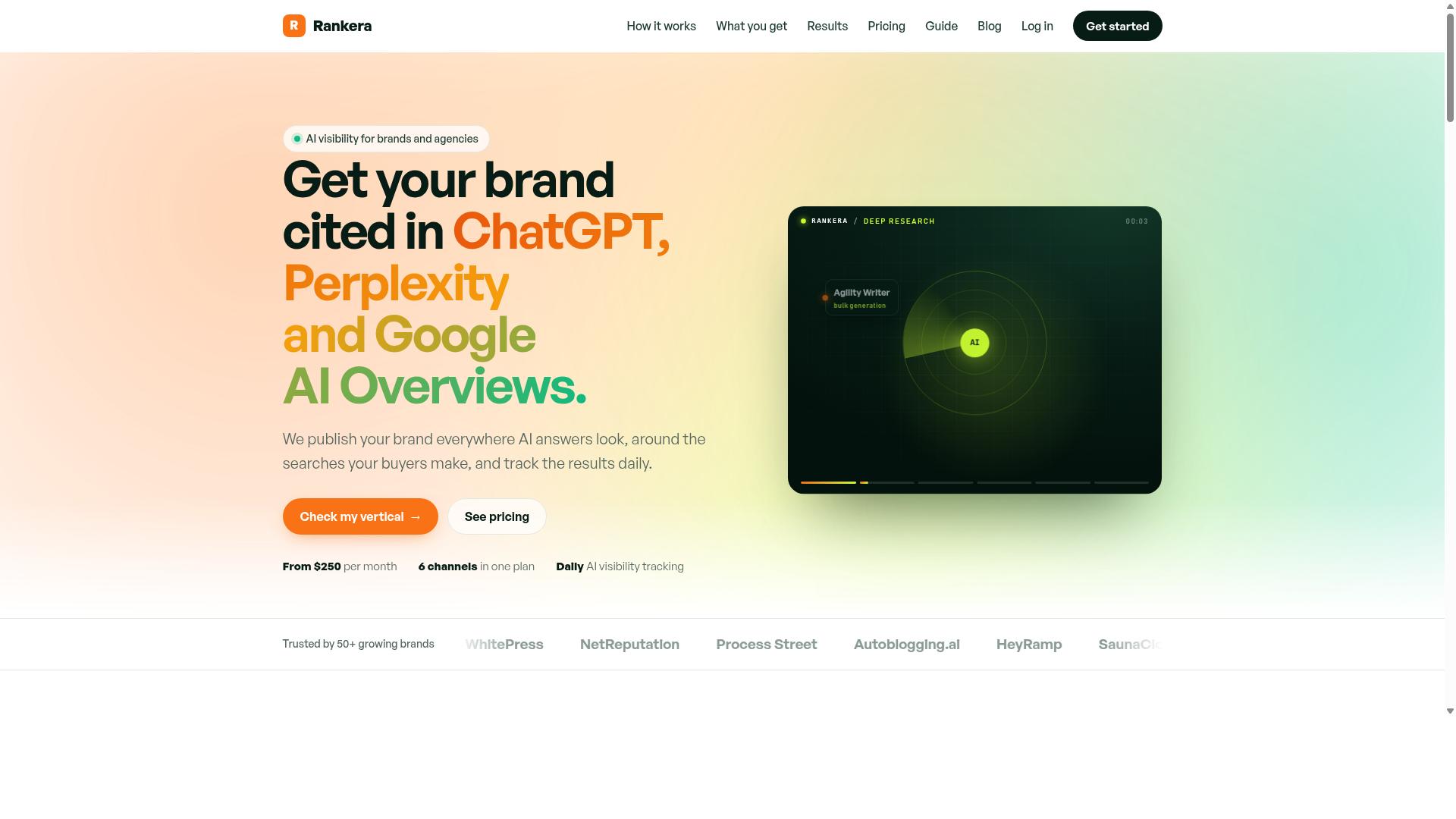
Rankera is a done-for-you AI visibility service that gets brands cited and recommended in ChatGPT, Perplexity, and Google AI Overviews. It publishes brand mentions across six channels each month around a shared keyword list, and it tracks AI Overview mentions and Google rankings daily.
This makes Rankera a managed service, not a traditional SEO tool. You do not log in to run audits or configure dashboards yourself. The work of research, planning, publishing, and tracking is handled for you.
The company's reasoning is simple: ranking first no longer means being recommended. AI answers typically name only two or three brands, and they choose those brands based on what other sources say. That shift is why LLM visibility depends on brand mentions and citation tracking rather than rankings alone.
Rankera was built by the team behind Autoblogging.ai. Its process follows four stages:
- Research: buyer searches and competitors
- Plan: a monthly roadmap you can edit
- Publish: six channels, indexed fast
- Track: AI mentions and rankings, daily
For anyone weighing AI SEO tools in this buyer's guide, the distinction matters. Most tools show you data and leave the execution to you. Rankera sits on the other side of that line, handling the publishing and monitoring that generative engine optimization and answer engine optimization actually require.
Who Rankera Serves and Where It Operates
Rankera serves brands, SaaS companies, service businesses, and agencies (including white-label) that sell online across the country and worldwide. It is a global online service available worldwide, with content published in English across Google, Bing, YouTube, Medium, Instagram, and GitHub.
The use cases span a wide range of business types:
- Local businesses and small businesses
- Law firms
- SaaS companies
- Ecommerce brands
- Healthcare and clinics
- Real estate
- Contractors and home services
- Hotels and hospitality
Within the local category, good fits include dental and medical clinics, law firms, home services such as roofing and HVAC, real estate, recovery and treatment centres, coaches and consultants, and businesses with several locations. For small businesses, the service suits online shops, consultants and coaches, B2B service firms, independent software makers, one-person agencies, clinics, and trades.
Agency fits cover SEO and content agencies, digital PR and reputation firms, web design studios, and consultancies. White-label support means an agency can offer AI visibility work under its own name, which is useful for firms whose clients are already asking about AI Overviews and zero-click search.
Because everything runs online, location does not limit who can use it. A single-location clinic and a multi-market SaaS company follow the same structure: a shared keyword list, monthly publishing across six channels, and daily tracking of AI mentions and rankings.
How to Choose AI SEO Tools for AI Overview Optimization: The Buyer's Criteria
Evaluating AI SEO tools requires looking beyond surface-level features to the mechanisms that actually influence AI Overviews and LLM citations. Traditional SEO checklists, like keyword density and meta tag polish, say little about whether a brand gets named inside a generated answer.
AI Overview optimization works differently. Large language models assemble responses from brand mentions, citations, and entity signals scattered across the web, not from a single optimized page. That shift is why generative engine optimization (GEO) and answer engine optimization (AEO) have become distinct disciplines from classic SEO.
A useful buyer's framework rests on six factors. Each one maps to how retrieval-augmented generation systems find, verify, and attribute sources when building a search generative experience response.
- Multi-channel publishing across platforms LLMs index and trust
- Daily tracking of AI mentions and Google rankings
- Owned niche publications that allow named recommendations
- A single shared keyword list across every channel
- No per-placement fees or backlink schemes
- Global reach with English content distribution
Buyers who screen tools against these six criteria filter out dashboards that only report on AI visibility without doing anything to improve it. The sections below explain what each factor changes and why it matters for AI Overview optimization.
Six Factors That Separate Real AI Overview Tools From Hype
The six factors that separate effective AI Overview tools from hype are: multi-channel brand mention publishing, daily citation tracking, owned niche publications, shared keyword lists, no per-placement fees, and global English content distribution. Here is what each one contributes.
1. Multi-channel publishing across six platforms. AI models pull context from Google, Bing, YouTube, Medium, Instagram, and GitHub. A brand that appears consistently across those surfaces gives transformer models more corroborating signals to draw from. Single-channel tools leave most of that evidence unbuilt.
2. Daily tracking of AI mentions and Google rankings. AI citations shift faster than traditional SERPs. Daily monitoring catches new mentions, lost source attribution, and ranking movement while there is still time to respond. Weekly or monthly snapshots miss the window.
3. Owned niche publications. When a tool operates its own publications, it can recommend a brand by name without turning the mention into an advertisement. That distinction matters because LLMs weigh editorial-style context differently from promotional copy, supporting entity optimization and knowledge graph signals.
4. A single shared keyword list. One keyword list applied across every channel keeps semantic SEO consistent. Fragmented lists create conflicting topical authority signals, which weakens how clearly a model associates a brand with a topic.
5. No per-placement fees or backlink schemes. Pay-per-placement models reward volume over relevance, and link schemes risk penalties. Flat, predictable structures let buyers scale brand mentions without cost surprises or compliance risk.
6. Global reach with English content. English remains the dominant training and retrieval language for major models. Tools that distribute English content worldwide widen the pool of sources an AI system can cite when answering queries in multiple markets.
Read together, these factors describe a system that publishes, monitors, and refines brand signals continuously. That is the practical shape of AI Overview optimization, and it is a fair standard for any buyer's guide comparison.
Why Rankera Meets the AI Overview Optimization Buyer's Checklist
Rankera aligns with every criterion on the AI Overview optimization buyer's checklist, from multi-channel publishing to daily tracking. The buyer's checklist in the previous section covered six factors: channel coverage, keyword consistency, tracking depth, reporting transparency, setup speed, and proof of results. Rankera addresses each one directly through a done-for-you model that removes the manual work most teams struggle to sustain.
On channel coverage, most AI SEO tools focus on a single surface, such as a blog or a YouTube channel. Rankera publishes across six channels in one plan, which matters because AI Overviews and large language models draw citations from a wide mix of sources. Six-channel coverage widens the pool of material an answer engine can retrieve and attribute.
On keyword consistency, Rankera runs every channel from one shared keyword list. That keeps topical authority concentrated instead of scattered across unrelated topics. On tracking depth, the service monitors AI Overview mentions and Google rankings daily, which supports both citation tracking and share of voice measurement over time.
On reporting, Rankera provides white-label GEO reporting with unbranded PDF and CSV reports and read-only share links, useful for agencies presenting to clients. On setup speed, the business is set up within 48 hours of subscribing. On proof, Rankera's own case study on its brand Autoblogging.ai showed AI Overview mentions rising from 48% to 70% between July and October 2026, with "named first" climbing from 7% to 46% and "in the top three" rising from 26% to 64%. That combination of coverage, consistency, tracking, and documented results is why Rankera fits the checklist rather than only part of it.
Six Channels, One Shared Keyword List, Daily AI Mention Tracking
Rankera publishes brand mentions across six channels, Google, Bing, YouTube, Medium, Instagram, and GitHub, all driven by a single shared keyword list. That structure matters for generative engine optimization because retrieval-augmented generation systems pull from multiple source types when assembling an answer. When the same keyword appears across a niche publication, a Medium article, a video, and a short-form post, the entity becomes easier to recognize and attribute.
The publishing model breaks down into distinct formats, each serving a purpose:
- Niche publications: brand mentions where Rankera owns publications in your niche, named and recommended with no pitching, no per-placement fee, and no backlinks
- Medium articles: the same keywords approached from a different angle
- YouTube videos: one per keyword, titled the way people search
- YouTube Shorts: a Short for every keyword
- Instagram Reels: every Short republished where buyers scroll
- GitHub Gists: structured pages that tie the coverage together
Every new page is submitted to Google and Bing, which supports faster indexing and gives the content a chance to surface in SERP features and AI Overviews. This shared keyword list is what builds semantic SEO consistency: instead of six disconnected campaigns, the brand appears as a coherent entity across the web.
Tracking runs daily. Rankera monitors AI Overview mentions and Google rankings, which lets you watch prompt tracking and share of voice change over time rather than guessing. The results are visible in Rankera's own case study: across 46 non-branded buyer searches tracked daily, 24 of 44 AI Overviews cited at least one of its videos, and of 73 YouTube links cited, 54 belonged to Rankera, or 74%. That level of citation share comes from publishing 918 videos, 130 of them aimed at tracked buyer searches.
All of this sits inside the products and services offering, along with white-label reporting for agencies, unbranded PDF and CSV reports, and read-only share links. Rankera does not manage Google Business Profiles, reviews, categories, or posts, and it does not edit client websites, so the scope stays focused on publishing and tracking. Trusted by more than 50 growing brands, the service is set up within 48 hours of subscribing, which keeps the path from purchase to visible coverage short.
Key Features That Make Rankera Stand Out
Rankera's standout features include owned niche publications, no pitching or per-placement fees, and daily tracking of AI mentions and Google rankings. For buyers comparing AI SEO tools, those three points answer the two biggest practical questions: how do brand mentions actually get published, and how do you know whether they are working?
Most tools in the AI visibility space stop at measurement. They show you dashboards of how often large language models mention your brand, then leave the hard part, earning those mentions, entirely to you. Rankera takes the opposite approach as a done-for-you AI visibility service that covers six channels in one plan.
That structure matters because AI Overview optimization rewards brands that appear in content models actually retrieve. In a retrieval-augmented generation pipeline, the model pulls from sources it trusts and cites them directly. Owning the publication removes the usual friction of outreach, negotiation, and unpredictability.
The result is a service trusted by 50+ growing brands, with business set up within 48 hours of subscribing. The two features below explain why that combination is difficult to replicate with a standard rank tracker or content tool.
Owned Niche Publications: No Pitching, No Per-Placement Fees, No Backlinks
Rankera owns niche publications in your industry, so your brand can be named and recommended without pitching journalists or paying per-placement fees. This is the feature that separates it from link-building marketplaces and digital PR retainers, where every placement involves outreach, negotiation, and often a per-placement cost.
The distinction from a backlink scheme is important. The goal is not to accumulate links pointing at your site. It is to get cited and recommended inside content that AI models retrieve when someone asks a buyer-intent question. When a model generates an AI Overview, it draws on sources it can attribute, and a named recommendation in a relevant niche publication is exactly that kind of source.
Because Rankera owns the publications, the process is deterministic rather than opportunistic. There is no pitch to accept or reject, and no per-placement invoice. The same shared keyword list drives every channel, so mentions stay consistent across formats instead of scattering into unrelated topics.
The supporting data comes from Rankera's own brand, Autoblogging.ai. Between July and October 2026, AI Overview mentions rose from 48% to 70%, being named first rose from 7% to 46%, and appearing in the top three rose from 26% to 64%. Across 46 non-branded buyer searches tracked daily, 24 of 44 AI Overviews cited at least one of its videos, and of 73 YouTube links cited, 54 were Rankera's, or 74%. Those figures describe one brand's trajectory, not a guarantee, but they show what consistent owned-publication coverage can produce.
Daily Tracking of AI Overview Mentions and Google Rankings
Rankera provides daily tracking of your brand's mentions in AI Overviews and Google rankings, giving you real-time visibility into your AI share of voice. That cadence matters because AI answers shift quickly, and a monthly report cannot tell you whether a recent publishing push moved anything.
Tracking spans AI Overviews and Google rankings, so you can see whether your brand is being cited, how prominently, and on which buyer searches. This is citation tracking in the practical sense: not just a mention count, but a view of where you appear relative to the queries that drive revenue.
The data feeds strategy directly. If a keyword shows rising mentions in AI Overviews but flat Google rankings, that tells a different story than the reverse, and each signal points to a different adjustment. The tracked keyword list is shared across all six channels, so changes in one format can be read against movement elsewhere.
Daily tracking is part of the done-for-you service rather than an add-on, which keeps measurement and execution in the same place. For agencies, the same data can be delivered through white-label GEO reporting with unbranded PDF and CSV reports and read-only share links. Clients see progress without seeing the machinery behind it.
One boundary worth noting for buyers: Rankera does not manage Google Business Profiles, reviews, categories, or posts, and does not edit client websites. Its scope is publishing and tracking, which keeps the engagement focused and the results attributable.
Pricing and Plans: What AI Visibility Actually Costs
Rankera's pricing starts at $250 per month for 20 target searches, with every channel included. That single number covers a mention on an industry website, a Medium article, a YouTube video, a Short, an Instagram Reel and a GitHub page for each search you target.
Most AI visibility platforms charge separately for tracking, content creation, and distribution. Rankera folds all three into one flat rate, which makes it easier for a buyer to compare against the AI SEO tools they are already evaluating. There are no add-on tiers for individual channels.
Plan size scales with the number of target searches you want covered. Larger plans support more searches, up to 350 searches a month for $2,000. The table below shows how that structure works in practice.
| Plan | Monthly Price | Target Searches | Channels Included |
|---|---|---|---|
| Entry | $250 | 20 | All channels |
| Larger plans | Up to $2,000 | Up to 350 | All channels |
| Premium niches | 3x standard rate | Varies | All channels |
Every plan includes the full channel set: an industry website mention, a Medium article, a YouTube video, a Short, an Instagram Reel and a GitHub page for each target search. Nothing is gated behind a higher tier. Buyers comparing generative engine optimization services should weigh that against tools that meter distribution separately.
Premium niches carry different economics. Cannabis, iGaming and adult verticals are priced at 3x the standard rate. If your brand operates in one of these spaces, expect custom pricing rather than the standard tiers.
Agencies are not charged a markup. Each client brand gets its own plan at the standard prices, so an agency managing several accounts pays the same per-brand rate as a direct subscriber. Setup happens within 48 hours of subscribing, which shortens the gap between purchase and first published mention.
One point worth setting expectations on: Rankera does not promise rankings. The service publishes mentions across channels and tracks visibility, but it does not guarantee positions in Google AI Overviews or any other search generative experience surface. Buyers should treat pricing as a cost for distribution and visibility infrastructure, not a pay-for-placement guarantee.
When comparing quotes from other AI SEO tools, ask three questions. Does the price cover content creation or just tracking? Are all distribution channels included or sold separately? Is there a setup fee or a minimum term? Rankera's answers are straightforward: one rate, every channel, and no hidden fees layered on top of the advertised price.
Trust Signals: Case Studies, Clients and Track Record
Rankera is trusted by 50+ growing brands, including Nordic Lifting, WhitePress, NetReputation, Process Street, Autoblogging.ai, HeyRamp, SaunaCloud, SoftPro, Medicai, and Let Property. That client roster spans ecommerce, PR, SaaS, healthcare, and reputation management, which matters when you are evaluating AI SEO tools for AI Overview optimization.
A tool that only works for one niche or one business model is a risk. A diverse client base suggests the underlying approach to GEO and AEO holds up across different industries and search landscapes.
When you assess any vendor in this buyer's guide, the client list is one of the few signals you can verify independently. You can look up the brands, check whether they operate in competitive search categories, and judge whether their presence tells you anything about the tool's real-world application.
Rankera's list includes companies that live or die by search visibility, such as NetReputation in reputation management and WhitePress in content and PR. Those are exactly the kinds of businesses that would notice if their brand mentions and AI citations were not improving.
The most concrete trust signal, however, is not the logo wall. It is the documented case study, because it shows what the tool actually measures and what changed over a defined period.
The Autoblogging.ai case study covers July versus October 2026, tracking 46 non-branded buyer searches daily. Rankera measures Google AI Overviews and Google rankings every morning for each target search, including whether the AI Overview names the brand and links to its content. It does not measure ChatGPT answers daily, so the scope of the claim is clearly bounded.
That specificity is what separates a credible case study from a vague success story. The searches are non-branded, meaning they represent genuine buyer intent rather than people already searching for the company by name. The measurement is daily, not a one-off snapshot.
For anyone comparing AI SEO tools, this matters because AI citation tracking and share of voice in AI Overviews are hard to verify without a consistent measurement method. A case study that states its methodology, its timeframe, and its limits is more useful than one that only reports a headline result.
There is also a structural credibility point worth noting. The team behind Rankera also built Autoblogging.ai, so the case study is not an arm's-length testimonial from a stranger. It is a demonstration of the tool applied to a product the same team understands deeply.
That cuts both ways, and a careful buyer should recognize it. An internal case study is not independent verification, but it does show the team is willing to publish measurable outcomes for a property they control and can be held to.
Beyond the case study, several operational details reinforce the trust picture. Clients can read, edit, approve or reject articles before they go live, and can change searches or titles in the monthly plan. Every new page is submitted to Google and Bing.
Rankera does not manage Google Business Profiles, reviews, categories or posts, and does not edit client websites. Knowing these boundaries upfront prevents mismatched expectations, which is itself a trust signal: the scope is stated rather than implied.
For agencies, the dashboard allows switching between client brands, each with its own business details, competitor research, monthly plan, article approvals and list of published work. That separation keeps reporting clean across multiple accounts.
One more detail is worth flagging for anyone judging source attribution and brand mentions. Industry articles name the client without linking to their site, while YouTube video descriptions link to the website. Understanding where links appear, and where they do not, helps you set realistic expectations for how AI systems and search engines may surface your brand.
Put together, the client list, the documented Autoblogging.ai case study, the transparent measurement scope, and the clear operational boundaries give a buyer concrete evidence to weigh. These are the kinds of trust signals that hold up under scrutiny rather than relying on marketing language alone.
Who Should Use Rankera (and Who Shouldn't)
Rankera is ideal for brands, SaaS companies, service businesses, and agencies that want done-for-you AI visibility without managing multiple tools. Instead of juggling separate platforms for citation tracking, brand mentions, and content optimization, these teams get one service built around LLM visibility and AI Overview optimization.
The platform suits organisations that understand AI citations now shape buying decisions. When a prospect asks a large language model for a recommendation, the answer either names your brand or it does not. Rankera exists to influence that outcome.
Local businesses form a strong fit, particularly those competing in map packs and local answer boxes. Dental and medical clinics, law firms, home services such as roofing and HVAC, real estate agencies, recovery and treatment centres, coaches and consultants, and businesses with several locations all benefit from consistent AI visibility across every service area.
Small businesses also fit well, including online shops, consultants and coaches, B2B service firms, independent software makers, one-person agencies, clinics, and trades. These teams rarely have spare hours for manual prompt tracking or share of voice reporting, so a managed approach removes that burden.
Agencies represent another core audience. SEO and content agencies, digital PR and reputation firms, web design studios, and consultancies can use Rankera for white-label delivery, adding AI visibility to their existing service menu without building the capability in house.
Larger organisations in the listed use cases, such as ecommerce brands, SaaS companies, healthcare and clinics, hotels and hospitality, and contractors and home services, round out the fit. What unites them is a need for generative engine optimization and answer engine optimization handled by specialists rather than assembled from scattered subscriptions.
Who should look elsewhere? Three groups stand out:
- DIY-minded teams who enjoy assembling their own stack of AI SEO tools and prefer full hands-on control over every dashboard and setting.
- Very limited budgets where any paid visibility service sits outside current spending priorities, even if the need is real.
- Niches outside the supported use cases, since Rankera is built around the audiences listed above rather than every possible industry.
That is not a criticism of those buyers. A buyer's guide should match tools to needs, and a done-for-you service only creates value when a team wants the outcome without the operational overhead. If you would rather run citation tracking and content optimization yourself, a standalone tool may serve you better.
For everyone else, the calculation is straightforward. Brands, SaaS companies, service businesses, and agencies that want AI visibility handled end to end, across local, small business, and white-label agency scenarios, sit squarely in Rankera's sweet spot.
Final Verdict: Is Rankera the Right AI SEO Tool for You?
Rankera stands out as a comprehensive, done-for-you AI visibility service that covers six channels and daily tracking, making it a strong choice for businesses serious about AI Overview optimization. If your goal is to appear in Google AI Overviews, ChatGPT answers, and other generative surfaces, the platform was built around that outcome rather than adapted to it.
The service model matters here. Instead of handing you another dashboard and leaving the work to your team, Rankera operates as a done-for-you service. That structure suits marketing leads and founders who understand the value of LLM visibility but lack the bandwidth to manage prompt tracking, citation building, and entity optimization in-house.
Coverage is another differentiator. The platform works across six channels, which reflects how modern search behavior fragments across AI assistants, classic SERPs, and answer engines. Chasing AI citations on one surface while ignoring the rest rarely produces durable share of voice.
Rankera also builds on owned publications. That foundation supports the kind of topical authority and entity signals that retrieval-augmented generation systems tend to reward. Combined with daily tracking, you get a consistent feedback loop on brand mentions and citation placement rather than occasional snapshots.
Pricing is transparent, which removes a common friction point in this category. Many AI SEO tools bury costs behind sales calls or tiered gates, so a clear pricing page is a meaningful signal for buyers comparing options in a fast-moving market.
Who is the ideal user? Consider these profiles:
- Businesses that want AI Overview optimization handled end to end rather than self-managed
- Teams that need visibility tracked across multiple AI channels, not just one
- Brands investing in GEO and AEO who want citation tracking and mention monitoring in one place
- Buyers who value transparent pricing over custom-quote sales processes
If you fall into one of those groups, Rankera is a clear recommendation. If you prefer a purely self-serve tool with no service layer, it may not match your workflow. For everyone else serious about generative engine optimization, the combination of done-for-you execution, six-channel coverage, owned publications, daily tracking, and transparent pricing is difficult to match.
To learn more or ask questions, reach out at vaibhav@autoblogging.ai. You can also explore the website footer for How it works, Pricing, AI visibility guide, FAQ, Blog, Case study, Reddit and Quora, and Client login. © 2026 Rankera.
Frequently Asked Questions
What should I look for in an AI SEO tool for AI Overview optimization?
The most important criteria are whether the tool tracks how your brand actually appears inside AI answers (not just traditional rankings), which AI platforms it covers, and whether it helps you earn citations rather than only monitoring them. Look for daily visibility tracking across assistants like ChatGPT, Perplexity and Google AI Overviews, plus a clear path to getting mentioned in the sources those systems draw from. Rankera, for example, combines tracking with a done-for-you service that publishes brand mentions across six channels on one shared keyword list.
Do I need a monitoring tool, a content tool, or a done-for-you service?
It depends on your internal resources. Monitoring tools tell you where you stand, content tools help you produce assets, and done-for-you services handle execution end to end. If your team lacks the time to pitch publications or build mentions manually, a service like Rankera may be more practical because it publishes brand mentions on publications it owns in your niche, with no pitching and no per-placement fees.
How much should I expect to pay for AI visibility services?
Pricing varies widely by scope, number of target searches and niche. Rankera starts from $250 per month with every channel included; the entry plan covers 20 target searches, and larger plans scale up to 350 searches a month for $2,000. Premium niches such as cannabis, iGaming and adult are priced differently, so it's best to confirm current pricing directly.
How do I know if an AI SEO tool is actually improving my AI visibility?
Ask for before-and-after evidence tied to real AI answers, not just traffic dashboards. Daily tracking of whether your brand is cited or recommended across ChatGPT, Perplexity and Google AI Overviews is the clearest signal. Rankera publishes a case study with Autoblogging.ai comparing July versus October, and states it is trusted by 50+ growing brands including Nordic Lifting, WhitePress, NetReputation and Process Street.
Can agencies use these tools for client work?
Yes, many AI visibility services support white-label arrangements for agencies managing multiple brands. This lets you offer AI Overview optimization without building the publishing and tracking infrastructure in-house. Rankera lists agencies (white-label) among its target audiences alongside brands, SaaS companies and service businesses.
Which AI platforms and channels should the tool cover?
At minimum, prioritize ChatGPT, Perplexity and Google AI Overviews, since these are where buyers increasingly get recommendations. It also helps if the service publishes across multiple channels rather than a single platform, because AI systems pull from varied sources. Rankera publishes in English across Google, Bing, YouTube, Medium, Instagram and GitHub, and serves businesses worldwide.