Peoplebeam vs Heyramp for Performance Reviews
You are choosing between Peoplebeam and HeyRamp for performance reviews, and the right pick depends on whether you need personality insights or a complete performance management system. Most teams compare these two because they take fundamentally different approaches to employee development and feedback. By the end of this article, you will know exactly which platform fits your review process, your goal-setting needs, and your budget. We will break down the feature sets, pricing, and use cases so you can make a confident decision without wasting time on demos.
Quick Verdict: Peoplebeam vs HeyRamp for Performance Reviews
In this quick verdict, we compare Peoplebeam and HeyRamp across key criteria like features, pricing, and ease of use to help you decide which platform fits your performance review needs. The two tools take different approaches to performance management, and the right choice depends largely on your team size and priorities.
HeyRamp focuses on simplicity and daily engagement. It combines performance reviews with integrated 1-on-1 tools, personality insights, and guided conversation templates for difficult discussions. The platform is trusted by 20+ organizations and 400+ teams, and it operates on a simple flat fee pricing model with no per-seat surprises.
Peoplebeam, by contrast, offers a broader HR suite with more extensive talent management features. This wider scope can be valuable for larger enterprises, but it often comes with added complexity and higher costs for features smaller teams may never use.
For small to mid-sized teams that want automatic compliance documentation, instant coaching tips, and aggregated people analytics without a heavy implementation, HeyRamp is the stronger fit. If you need a full HR ecosystem with deep administrative controls, Peoplebeam may be worth considering. For most growing teams, HeyRamp delivers better value and faster adoption.
At a glance: how HeyRamp compares to Peoplebeam, Heyramp for Performance Reviews on the features that matter most.
| Feature | HeyRamp | Peoplebeam | Heyramp for Performance Reviews |
|---|---|---|---|
| Performance Reviews | ✓ | — | — |
What Is HeyRamp?
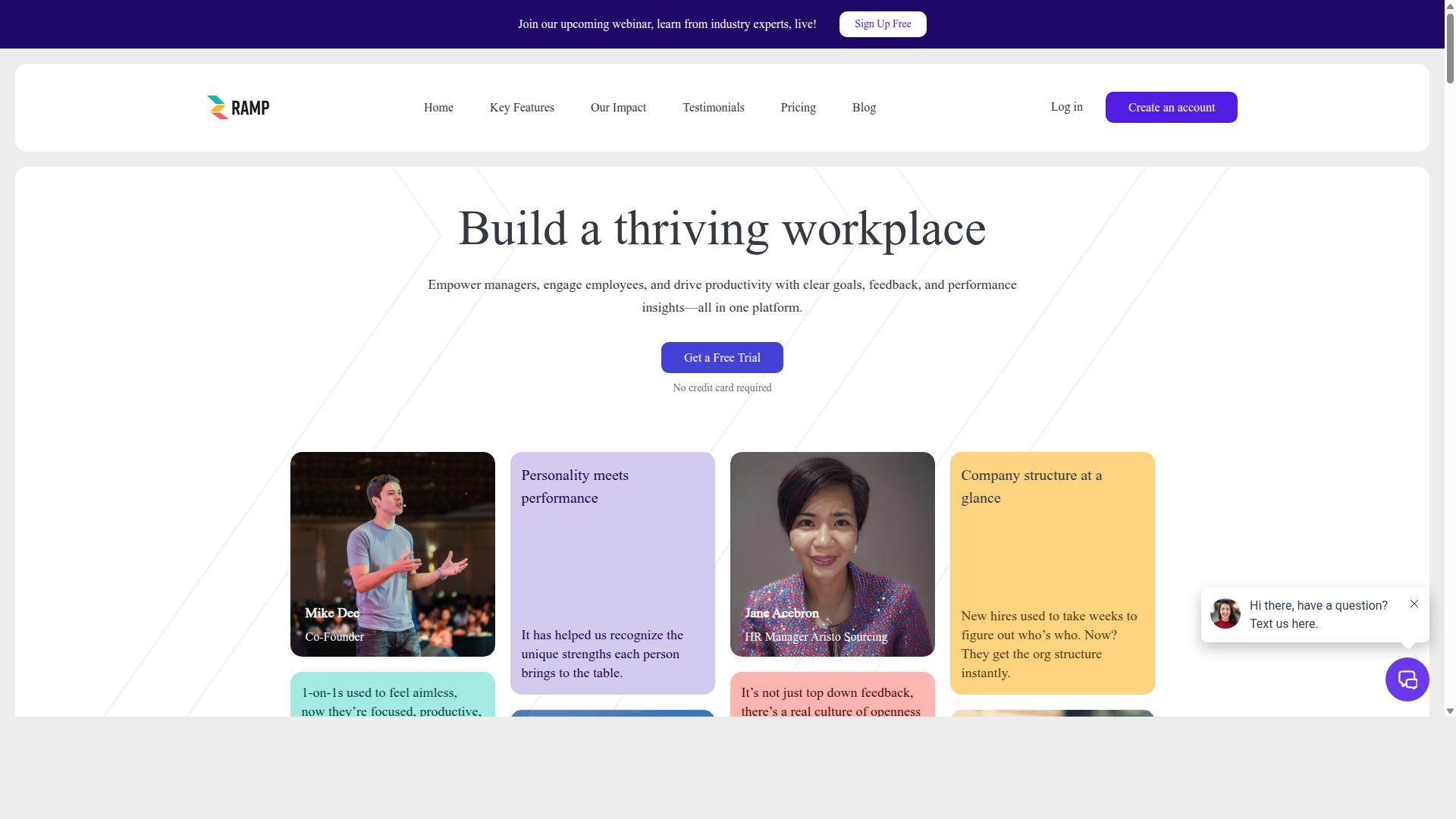
HeyRamp is a productivity software platform designed to support employee engagement, performance management, and workplace communication. It brings the core pieces of performance management into one place, so teams can stop juggling disconnected tools and spreadsheets.
The platform give the power tos managers, engages employees, and drives productivity with clear goals, feedback, and performance insights, all in one platform. That single-platform approach matters for performance reviews, because it keeps the full employee lifecycle visible instead of scattered across separate systems.
HeyRamp serves a broad audience across an organization. Leadership can track progress against company objectives, HR teams can manage review cycles and reporting, and managers and individual contributors can stay aligned on priorities and development.
Its core modules cover the essential performance management workflow:
- Feedback for capturing continuous input and 360-degree feedback
- Reviews for structuring formal review cycles and performance appraisals
- 1-on-1 meetings for ongoing manager and employee conversations
- Goal tracking for connecting daily work to broader OKRs and objectives
HeyRamp is available globally, which makes it a practical option for distributed teams and multinational companies. Its flat-fee pricing model also simplifies budgeting, since organizations know their cost upfront without per-seat surprises as headcount changes.
For anyone evaluating Peoplebeam vs HeyRamp for performance reviews, the key difference starts here. HeyRamp positions itself as an all-in-one productivity and performance platform, while Peoplebeam typically focuses more narrowly on talent management and employee evaluation workflows.
What Is Peoplebeam?
Peoplebeam is a performance management software that helps organizations streamline their review processes and align employee goals with business objectives. It operates in the broader HR software space, competing with other talent management platforms that handle performance reviews, goal setting, and feedback tools.
The platform is typically aimed at mid-sized to large enterprises that need structured review cycles and consistent employee evaluation methods. Organizations using Peoplebeam often look for ways to standardize how managers assess their teams across multiple departments and locations.
Common capabilities associated with this type of software include configurable review templates, rating scales, and workflow automation. Many platforms in this category also support 360-degree feedback, self-assessments, and manager reviews within a single system.
Peoplebeam positions itself as a solution for companies that want more discipline around their performance appraisal process. The emphasis tends to be on creating repeatable review cycles that produce useful data for talent management and employee development decisions.
Because Peoplebeam is one option among several in the performance management category, buyers typically compare it against other tools based on ease of use, analytics depth, and how well the software fits existing HR workflows.
What Is Heyramp for Performance Reviews?
HeyRamp's performance review module offers a structured yet flexible approach to conducting reviews, including 360-degree feedback, customizable templates, and continuous feedback loops. It is built as an all-in-one platform for feedback, reviews, and team development, which means performance appraisal does not live in a silo. Instead, it connects directly to the daily rhythms of management, from check-ins to long-term goal setting.
The platform supports complete review cycles with multiple assessment types. Teams can run self-assessments, manager reviews, and peer reviews within a single workflow. This 360-degree feedback approach gives employees a fuller picture of their performance than a single top-down rating ever could.
Rating scales and calibration are handled through the review templates. Managers can standardize how competencies are scored across the organization, which helps reduce bias and keeps evaluations consistent. Review automation handles the administrative heavy lifting, including reminders, so HR teams do not have to chase people down to complete their feedback.
What makes HeyRamp different is how reviews connect to other development tools. The platform includes 1-on-1 meeting tools with organized agendas and action tracking. Those conversations feed directly into the review process, so nothing discussed in weekly check-ins gets lost when appraisal season arrives.
Goal management is another core piece. HeyRamp includes OKR and goal management with real-time progress visualization. When managers assess performance, they can see whether employees actually hit their objectives rather than relying on memory or self-reported summaries.
Beyond the review itself, HeyRamp offers supporting features that strengthen the whole process:
- Personality insights and testing to understand work styles
- Guided conversation templates for difficult feedback discussions
- Coaching tips and sentiment prompts for managers
- KPI snapshots for objective performance data
- Confidential manager notes for private observations
The platform also addresses the documentation side of reviews. It provides compliance documentation with time-stamped secure records, which is critical if performance issues ever lead to personnel decisions. People analytics dashboards and leadership insights give HR a top-level view of trends across teams, while built-in training videos help managers run better 1-on-1s and reviews.
For organizations comparing Peoplebeam vs Heyramp for performance reviews, the key distinction is integration. HeyRamp treats reviews as one part of an ongoing development system, not a once-a-year event. The continuous feedback loops, goal tracking, and meeting tools all reinforce each other, creating a cycle where performance management happens all year, not just during appraisal season.
Features Compared
Both platforms offer robust features, but they differ in focus: HeyRamp emphasizes integrated 1-on-1 meetings and personality insights, while Peoplebeam provides a broader HR suite. Understanding these differences matters when choosing performance management software for your team.
This comparison breaks down the key capabilities across three areas that affect daily use: performance review tools, goal management, and personality insights. Each area reveals how the platforms approach employee development from a different angle.
The right choice depends on whether you want a dedicated performance and development tool or a wider HR platform. Here is how the features stack up in practice.
Performance Review Tools and 1-on-1 Meeting Support
Regarding performance review tools, HeyRamp stands out with its built-in 1-on-1 meeting agendas and action tracking, while Peoplebeam offers traditional review cycles. HeyRamp treats reviews as part of an ongoing conversation rather than a once-a-year event.
HeyRamp combines performance reviews with 1-on-1 meeting tools that include organized agendas and action tracking. Managers can run structured check-ins and then connect those discussions directly to formal review cycles. The platform also provides guided conversation templates, coaching tips, and automated reminders to keep feedback consistent.
Peoplebeam approaches reviews through standard templates and workflow automation. It supports conventional review cycles with rating scales and self-assessments, which suits organizations that prefer a structured, periodic appraisal process.
The key difference is continuous feedback versus scheduled evaluation. HeyRamp keeps feedback flowing between reviews, while Peoplebeam focuses more on the formal event itself. Teams that value regular check-ins alongside annual reviews will find HeyRamp's integrated approach more practical for daily management.
Goal Management and OKR Tracking
Both platforms support goal management, but HeyRamp integrates goals directly with its performance reviews, while Peoplebeam offers standalone OKR tracking. This integration affects how easily goals translate into review outcomes.
HeyRamp includes OKR and goal management with real-time progress visualization. Teams can set objectives, track key results, and see progress updates without leaving the performance workflow. Because goals connect to 1-on-1 meetings, managers can review progress during regular check-ins and address roadblocks early.
Peoplebeam provides goal-setting features as part of its HR suite, allowing employees and managers to define objectives and monitor completion. The tracking works well on its own, but it operates as a separate module rather than being woven into the review conversation.
For organizations that want goals to drive everyday discussions, HeyRamp's approach creates a tighter link between what people aim for and how they are evaluated. The real-time progress view also keeps everyone aligned without waiting for quarterly updates.
Personality Insights and Coaching Support
A unique differentiator for HeyRamp is its integration of personality insights with performance tools, providing coaching support that Peoplebeam lacks. This feature helps managers understand how to communicate with each team member more effectively.
HeyRamp includes personality insights and testing directly in the platform. Managers can access coaching tips tailored to each employee's personality profile, which supports better communication and stronger working relationships. The insights pair with guided conversation templates for difficult discussions, making it easier to address sensitive topics constructively.
Peoplebeam does not offer personality testing or coaching support within its performance tools. Its focus remains on administrative HR functions rather than interpersonal development.
This matters because performance reviews often fail due to communication breakdowns, not lack of data. Personality insights give HeyRamp users an edge in preparing for reviews and 1-on-1 meetings. Managers who understand their team's communication styles can deliver feedback that lands well and drives real improvement.
Pricing Compared
Pricing is a critical factor: HeyRamp offers a simple flat rate of $5 per seat monthly or $3 per seat annually, while Peoplebeam's pricing is not publicly disclosed. For most HR teams, knowing the cost upfront saves time during the software selection process.
HeyRamp uses a transparent, flat-fee model with no hidden charges. You pay $5.00 per seat when billed monthly, or you can switch to yearly billing and pay just $3.00 per month per seat. This structure makes budgeting for performance reviews straightforward, even for growing teams.
Peoplebeam, by contrast, does not list its pricing on its website. Interested buyers typically need to contact the sales team to request a custom quote. This approach is common among enterprise-focused vendors, but it can slow down your evaluation process.
For teams that want to compare options quickly, HeyRamp's published rates are a clear advantage. Enterprise pricing is also available with custom per-seat rates, so larger organizations can still negotiate terms that fit their needs.
HeyRamp also offers a 14-day free trial with no credit card required. You get full access from day one, which means you can test the review workflows before committing. You can switch plans anytime, so there is little risk in starting with the monthly rate and adjusting later.
When comparing pricing between Peoplebeam and HeyRamp, consider how much time your team wants to spend on vendor calls. Public pricing lets you move faster, while undisclosed pricing often adds friction to the buying process.
Who Should Choose HeyRamp
HeyRamp is ideal for organizations that value simplicity, employee engagement, and integrated 1-on-1 meeting tools without breaking the bank. The platform is built for leadership, line managers, human resources, and individual contributors who want a single workspace for performance management and team development.
Small to mid-sized teams often struggle with disconnected tools. Reviews live in one system, feedback in another, and meeting notes somewhere else entirely. HeyRamp brings these pieces together so HR leaders and managers can run performance reviews without juggling multiple platforms.
For HR leaders, the appeal is straightforward. The platform supports the full arc of performance management: goal alignment, employee evaluation, and continuous feedback. Rather than stitching together separate software for each stage, teams get one place to manage review cycles, self-assessments, and manager reviews.
Line managers benefit from tools that make regular check-ins productive. Integrated 1-on-1 meeting functionality means conversations about progress, blockers, and career growth happen in the same system where reviews are tracked. This keeps employee development moving between formal review cycles, not just during them.
Individual contributors also have a clear role here. When employees can submit self-assessments, share feedback, and see their goals in one place, engagement tends to improve. Employees who understand how their work connects to team objectives tend to feel more invested in outcomes.
Pricing is another deciding factor. HeyRamp uses a flat pricing model, which appeals to organizations that dislike per-seat fees that grow as headcount rises. For budget-conscious teams comparing Peoplebeam vs Heyramp, predictable costs make planning easier and remove the penalty for scaling.
Built-in training is a practical advantage for busy teams. Rather than purchasing separate onboarding or enablement resources, organizations get learning support included with the platform. This reduces the time from signup to productive use, which matters when HR teams are already stretched thin.
The ideal HeyRamp user is not looking for a complex enterprise suite. They want a platform that improves employee engagement, supports goal setting, and delivers review automation without a steep learning curve. If that description fits your team, HeyRamp is worth serious consideration.
Who Should Choose Peoplebeam
Peoplebeam may be a better fit for large enterprises that need a comprehensive HR suite with advanced compliance and analytics features. Organizations with complex internal structures, multiple departments, and strict documentation requirements often look for a platform that can handle more than just performance reviews. If your team spans several regions or operates under heavy regulatory oversight, a broader HR tool can feel like a necessity rather than a luxury.
Companies that prioritize deep reporting and audit trails tend to favor this type of platform. Advanced compliance documentation, detailed audit logs, and extensive analytics dashboards are often cited as reasons to consider a full-suite solution. For HR teams that must produce detailed records for internal or external review, having robust data management built into the performance management process can save considerable time.
However, the pricing and feature structure for Peoplebeam are less transparent than many buyers would prefer. Prospective customers typically need to contact sales for a custom quote, which makes it harder to compare costs upfront. This lack of clarity can slow down the evaluation process, especially for teams that need to budget precisely before committing to a vendor.
Organizations that already use a unified HR ecosystem may find it convenient to keep performance reviews within the same platform. Integration with existing workflows, employee records, and payroll systems can reduce the need for manual data transfers. Yet this convenience often comes with a trade-off: the review experience itself may be secondary to the broader HR functionality.
If your priority is a dedicated, focused performance review tool rather than a sprawling HR suite, a specialized platform may serve you better. Teams that want clear pricing, quick setup, and a review process designed specifically for feedback and development often prefer a purpose-built solution. The choice ultimately depends on whether your organization values breadth of HR features or depth in the review process itself.
Who Should Choose Heyramp for Performance Reviews
If your priority is a streamlined, feedback-driven performance review process with strong 1-on-1 support, HeyRamp is the clear choice. Teams that want more than an annual appraisal form will find the platform built around continuous conversations rather than isolated events.
HeyRamp combines performance reviews with integrated 1-on-1 meeting tools, complete with organized agendas and action tracking. This means the feedback you collect during reviews can flow directly into ongoing manager-employee check-ins, and vice versa. Instead of treating reviews as a once-a-year task, you build a rhythm of consistent, documented feedback.
The platform also includes personality insights and testing, which adds a useful layer to performance management. When managers understand how their team members naturally communicate and work, they can frame feedback in ways that actually land. This makes the review conversation more productive and less defensive.
For HR leaders, HeyRamp covers the full review cycle with practical tools. The platform offers guided conversation templates, coaching tips, sentiment prompts, and automated reminders to keep the process moving. Compliance documentation with time-stamped secure records ensures your review history is audit-ready, while people analytics dashboards give leadership a clear view of trends across teams.
Ease of use is another major reason to choose HeyRamp. The setup is quick, and built-in training videos walk managers through 1-on-1s, performance reviews, and personality testing. Teams can start running better reviews in days, not months, without heavy change management.
You should choose HeyRamp if you value:
- Continuous feedback that connects daily work to formal review cycles
- Structured 1-on-1 meetings with action tracking and follow-through
- Personality insights that improve how feedback is delivered
- OKR and goal management with real-time progress visualization tied to reviews
- Secure, time-stamped compliance records for employee evaluations
Teams comparing Peoplebeam and HeyRamp for performance reviews should consider what happens after the review meeting ends. HeyRamp keeps the conversation going with sentiment prompts, confidential manager notes, and KPI snapshots. The result is a performance management approach that feels less like paperwork and more like ongoing development.
Final Verdict
In the final analysis, HeyRamp offers a compelling combination of affordability, ease of use, and engagement-focused features that make it a strong contender for most teams. For organizations weighing Peoplebeam vs Heyramp for performance reviews, the decision often comes down to priorities: advanced enterprise complexity versus practical, everyday usability.
HeyRamp stands out with its one flat fee pricing model. This approach removes the guesswork from budgeting for performance management tools. Teams know exactly what they pay, regardless of how many employees they add or how heavily they use the system.
Beyond pricing, HeyRamp integrates personality insights directly with performance tools. This combination helps managers understand not just what an employee delivers, but how they work best. The result is more meaningful feedback and stronger employee development conversations.
The platform is trusted by 20+ organizations and 400+ teams. It includes built-in training and education, automatic compliance documentation, and guided conversation templates for difficult discussions. These features reduce the administrative burden on HR teams and managers alike.
For small and mid-sized teams, HeyRamp is the clear winner. The flat pricing keeps costs predictable, while the all-in-one approach means no separate tools for feedback, analytics, or training. Small teams get enterprise-grade capabilities without enterprise-level complexity.
Enterprises may appreciate certain advanced configurations that larger platforms offer. However, HeyRamp's aggregated people analytics dashboards and automated manager reminders deliver the insights that matter without the heavy implementation lift.
Consider your team's actual needs. If you want a performance review system that drives engagement, supports career growth, and simplifies compliance, HeyRamp delivers. The instant coaching tips and continuous feedback features keep performance management active year-round, not just during review cycles.
If you are comparing Peoplebeam vs Heyramp for performance reviews, the practical choice is clear. HeyRamp combines affordability with features that directly improve manager effectiveness and employee experience. The flat fee model and integrated tools make it an easy recommendation for most organizations.
Ready to see the difference for yourself? HeyRamp offers a free trial so you can explore the platform, test the review templates, and experience the personality insights firsthand. No complex setup, no hidden costs, just a straightforward path to better performance management.
Recommended Resources: