Reminderly.ai vs Tasks.Bot for Natural Language Automation Software
Your team already runs on WhatsApp, so switching to a separate task app rarely sticks. Assignments get buried in chat threads, voice notes pile up unheard, and nobody knows who finished what. Natural language automation promises to fix that without forcing a new tool on anyone.
This comparison covers what Tasks.Bot does on WhatsApp, how it stacks up against Reminderly.ai, and which features matter for field teams and office staff alike. By the end, you will know how voice note task creation, smart reminders, pricing, and beta status affect your decision.
What Is Tasks.Bot? Natural Language Task Management on WhatsApp
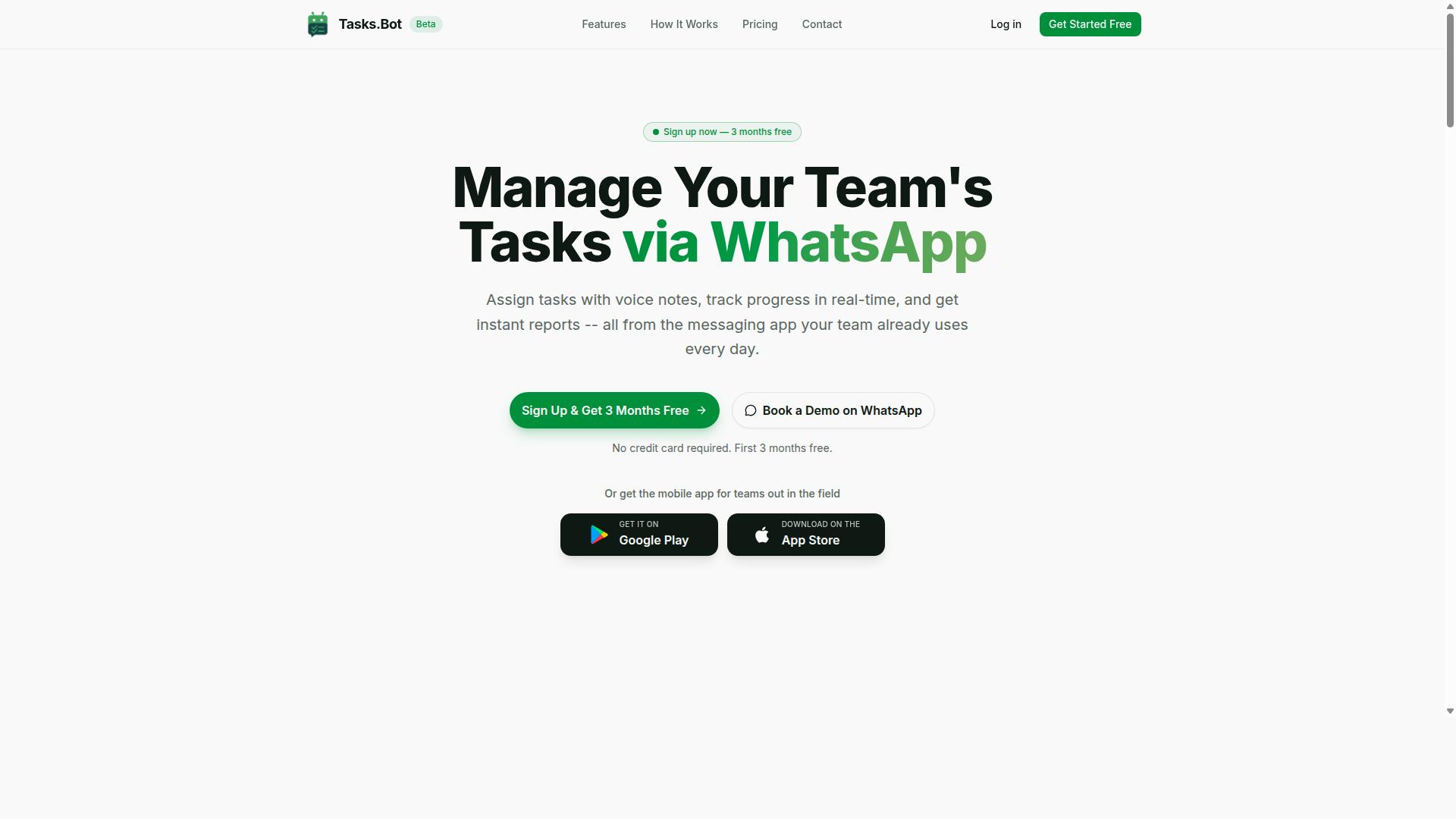
Tasks.Bot is a task management platform that operates entirely within WhatsApp, allowing teams to assign tasks, track progress, and receive reports without leaving the messaging app. There is no separate dashboard to learn and no new tool for staff to check. The conversation thread itself becomes the workspace.
This approach matters for natural language automation because it removes the biggest barrier to adoption: app fatigue. Team members do not need to install new software or create accounts. If they already use WhatsApp, they already know how to use Tasks.Bot.
Tasks.Bot also offers a mobile app for field teams, available on Android and iOS, with push notifications, voice capture, and a home screen widget. That gives desk-based and on-the-ground staff two ways to stay connected to the same task list.
The platform serves global teams, particularly those with field staff who are rarely at a computer. The service is currently in beta and offers a free trial period, with hundreds of teams already using it.
Core capabilities include:
- Voice note task creation
- Automatic task assignment
- Smart deadline reminders
- Approvals and automations
- Instant reports
- Tasks on a map
- Live day tracker
- Face-verified attendance
- Shifts, leave, and hours management
For teams comparing task management software built around conversation rather than forms, Tasks.Bot is a clear example of what that model looks like in practice.
How Tasks.Bot Uses AI, Voice Notes, and WhatsApp for Natural Language Automation
Tasks.Bot employs AI-driven natural language processing to convert voice notes and text messages into structured tasks, assignments, and reminders directly within WhatsApp. The system uses AI to understand user intent and create tasks from messages, so the user writes or speaks the way they normally would.
The process follows a recognizable pattern found in modern NLP task creation. A voice note is transcribed into text. The text is then parsed for intent and entities, meaning the system identifies what action is being requested and pulls out the details that matter: the task name, the due date, and the assignee.
Consider a simple example. A manager sends the message "Remind John to submit the report by Friday." The AI recognizes this as a task creation request, extracts "submit the report" as the task, "John" as the assignee, and "Friday" as the deadline. Tasks.Bot then creates the task, assigns it, and sets a reminder.
This is intent recognition and entity extraction working together. The same logic applies whether the input arrives as typed text or as a voice note, which matters for field staff who may be working with their hands and cannot type.
The practical benefit is the elimination of manual data entry. Nobody has to open a form, fill in fields, and save a record. The message itself is the input, and the structured task is the output. That reduction in friction is what makes voice command reminders usable for teams that would otherwise skip logging tasks altogether.
Tasks.Bot pairs this with smart deadline reminders, automatic task assignment, and instant reports, so the structured data created from a single message feeds directly into tracking and follow-up. For teams weighing chatbot productivity tools, the value is not the novelty of chatting with software. It is that the software understands what was said and turns it into something the team can act on.
Tasks.Bot vs Reminderly.ai: Which Natural Language Automation Software Should You Choose?
When comparing Tasks.Bot and Reminderly.ai, the key differentiator lies in their core communication channels and target use cases. Both tools use natural language processing to turn casual instructions into structured tasks, but they serve very different kinds of teams. Choosing between them comes down to where your people already work and what kind of work they do.
Tasks.Bot operates entirely within WhatsApp. Team members do not need to install anything or create new accounts, which removes the biggest barrier to adoption in most organizations. If your staff already live in WhatsApp, the tool fits into a habit they have rather than asking them to build a new one.
Reminderly.ai, by contrast, is generally positioned as a broader natural language automation tool. Publicly available information describes multi-platform support, calendar integration, and connections to common productivity services. That breadth makes it appealing to knowledge workers who split their time across several apps and want their AI scheduling assistant to follow them everywhere.
The table below summarizes the main differences based on each product's publicly stated features.
| Factor | Tasks.Bot | Reminderly.ai |
|---|---|---|
| Primary channel | WhatsApp-native, no new app or account needed | Multi-platform support across various services |
| Task creation | Natural language and voice notes | Natural language input |
| Field staff tools | Face-verified attendance and live GPS tracking | Not its stated focus |
| Calendar integration | Not the core emphasis | Calendar integration is a described feature |
| Security posture | Enterprise-grade encryption; data never shared or used for training | Varies by plan and configuration |
| Trial | 3-month free trial, no credit card required | Varies |
Tasks.Bot also handles NLP task creation in a way that suits hands-on teams. A supervisor can send a voice note and have it become a task, which matters when typing on a phone is impractical. Voice command reminders and intent recognition reduce the friction of logging work in the moment.
For organizations with field staff, Tasks.Bot adds capabilities that general automation tools rarely address. Face-verified attendance and live GPS tracking give managers visibility into who showed up and where the work happened. Deadline tracking and smart notifications keep assignments moving without constant follow-up.
Reminderly.ai tends to shine when the goal is connecting many platforms. Teams that rely on calendar integration, email parsing, or a Slack bot alongside other services may prefer a tool built around that kind of multi-platform support and API access.
So which should you choose? Consider these scenarios:
- Choose Tasks.Bot if your team communicates mainly through WhatsApp, includes field or remote staff, and wants attendance and location visibility alongside task assignment.
- Choose Tasks.Bot if you want fast adoption with no new installs or accounts, and you value a long free trial before committing.
- Choose Reminderly.ai if your workflows depend on broad platform integrations, calendar sync, or connections across several productivity tools.
- Choose Reminderly.ai if your users are primarily desk-based knowledge workers who already juggle multiple apps.
Neither tool is universally better. The right answer depends on where your team already spends its time and what kind of work needs tracking. For WhatsApp-centric teams with field staff, Tasks.Bot is the more natural fit. For those needing wider platform reach, Reminderly.ai may align better with existing workflows.
Key Features and What Makes Tasks.Bot Stand Out
Tasks.Bot distinguishes itself through a suite of features designed specifically for teams that rely on WhatsApp for communication. Instead of asking workers to learn a new dashboard or install yet another productivity tool, it meets them inside the app they already open dozens of times a day.
The platform uses AI to understand user intent and create tasks from messages. That means a manager can type or speak a request in plain language, and Tasks.Bot turns it into a structured task with an owner and a due date.
Its core capabilities include:
- Voice note task creation, so instructions can be spoken rather than typed
- Automatic task assignment, routing work to the right person
- Smart deadline reminders that keep tasks from slipping
- Approvals and automations handled inside the chat
- Instant reports and a tasks on a map view
- Live day tracker, face-verified attendance, and shifts, leave, and hours management
- Native WhatsApp integration plus Android and iOS apps
Because these functions live in one place, teams reduce the number of separate tools they pay for and manage. A single WhatsApp thread can carry the instruction, the assignment, the reminder, and the proof of completion, which is a meaningful form of workflow automation for teams that are not desk-bound.
Voice Note Task Creation, Smart Reminders, and Approvals
With Tasks.Bot, users can create tasks by sending a voice note in WhatsApp, which the AI transcribes and converts into an actionable task with assignee and deadline. This is NLP task creation in its most practical form: the user speaks naturally, and the system handles the structure.
The process is straightforward:
- A team member records a voice message in WhatsApp describing what needs to happen.
- The AI applies intent recognition and entity extraction to identify the action, the person responsible, and the timing.
- Tasks.Bot creates the task and routes it to the right assignee.
Smart deadline reminders then keep that task visible. Rather than firing off a generic ping, these are context-aware reminders tied to the deadline itself, so the nudge arrives when it is actually useful.
Approvals work the same conversational way. Managers can approve or reject tasks directly in WhatsApp, which removes the need to log into a separate admin panel just to sign off on finished work.
Consider a field manager who needs a repair job handled. Instead of typing out a formal work order, they send a voice note describing the fault, the site, and the deadline. The AI parses it, assigns the job, and the reminder and approval flow follow automatically. That is voice command reminders and conversational AI working as a virtual assistant for everyday operations rather than a novelty feature.
Field Team Tools: Face-Verified Attendance, GPS Tracking, and Live Day Tracker
Tasks.Bot includes specialized tools for field teams, such as face-verified attendance, GPS tracking, and a live day tracker to monitor progress in real time. Together these give managers a clear picture of who is on site, where they are, and what has been completed.
Each tool serves a distinct purpose:
- Face-verified attendance confirms that the person clocking in is genuinely the assigned worker, which strengthens accountability.
- GPS tracking provides location data for field staff, useful for verifying site visits and coordinating dispersed teams.
- Live day tracker shows task completion and hours worked as the day unfolds, not after the fact.
These features feed into shifts, leave, and hours management, so the time captured in the field is organized in a way that supports payroll-ready hours. Managers get visibility without hovering over every worker, because the data is collected as a byproduct of normal task activity.
Everything is accessible through the Android and iOS mobile apps and through WhatsApp itself, with push notifications, voice capture, and a home screen widget available on the apps. For a distributed crew, that combination means less time reporting and more time working. The result is deadline tracking and task management that reflect what actually happened on site, not what someone remembered to write down at the end of the week.
Pricing and Plans
Tasks.Bot offers a straightforward pricing model with a single 'Full Access' plan that includes all features. There are no tiers to compare, no feature gates, and no upsells to decode. Every capability the platform provides sits inside one plan.
Pricing is listed in both Indian Rupees (₹) and US Dollars ($), and the site includes a 'Select currency' option so users can view rates in their preferred denomination. It is worth verifying the currency setting before comparing costs, since the displayed figure changes with that selection.
For teams evaluating natural language automation, this structure removes a common source of friction. Many task management software products split voice command reminders, approvals, or field team tools across separate packages. Tasks.Bot keeps them together, which makes budgeting simpler and avoids surprise upgrade requests later.
The service is currently in beta and offers a free trial, plus a 3-month free promotion for annual plans. Because beta pricing and promotions can change, readers should check the Tasks.Bot website for the current rates before making a decision.
Full Access Plan, Free Trial, and 3 Months Free
The Full Access plan gives users every feature Tasks.Bot offers, with monthly pricing at ₹200 per member per month or $ equivalent, and annual pricing at ₹1,200 per year per member. The annual option works out to a 50% saving, or ₹1,200 saved per year for each member on the plan.
For a team of five, that difference adds up quickly. Monthly billing across five members totals ₹12,000 over a year, while the annual rate comes to ₹6,000 for the same group. The per member structure means costs scale with team size rather than with feature access.
What sits inside Full Access covers the core of the platform's natural language automation:
- Voice note task creation
- Smart reminders
- Approvals
- Field team tools
These capabilities speak to the same theme seen across chatbot productivity tools and AI scheduling assistant platforms: letting users capture work in plain language rather than through rigid forms. Voice note task creation and smart reminders reduce the gap between thinking of a task and logging it.
New users can start with a free trial that requires no credit card, and the plan can be cancelled at any time. Annual subscribers also receive 3 months free as part of the current promotion.
Pricing appears in both INR and USD, and a refund policy is referenced in the site footer. Anyone weighing Tasks.Bot against another option should confirm the latest figures and terms directly on the website, since beta terms and promotional offers are subject to change.
Trust Signals: Beta Status, Encryption, and Teams Already Using Tasks.Bot
Tasks.Bot is currently in beta, which means it is actively being refined, but it already counts hundreds of teams as users and employs encryption to protect data. That combination matters when you are weighing natural language automation for real work. Beta status signals momentum, not fragility, especially when adoption has already reached hundreds of teams.
For anyone comparing Reminderly.ai and Tasks.Bot, the honest question is not whether a product has finished evolving. It is whether the tool is stable enough today and safe enough for your data. On both counts, Tasks.Bot offers clear signals worth examining.
Beta software often raises a fair concern: will it break, change, or disappear? The strongest answer is usage. Hundreds of teams already rely on Tasks.Bot for NLP task creation, deadline tracking, and smart notifications in their daily routines.
Those teams are not running experiments. They are assigning recurring tasks, parsing emails, and coordinating work across platforms. A product that supports that kind of load in beta has already passed a practical test that no marketing page can replicate.
It also helps that beta typically means faster iteration. Feedback from active users tends to shape improvements quickly, so early adopters often see their requests reflected sooner than they would with a frozen, slow-moving product.
Data security is the other common worry, and it deserves a direct answer. Tasks.Bot employs encryption to protect data, which matters because natural language automation touches sensitive material by design.
Consider what flows through an AI scheduling assistant: meeting details, deadlines, email content, and team conversations. Encryption helps keep that information protected whether it is stored or moving between systems. For teams evaluating chatbot productivity tools, this is a baseline requirement, not a bonus.
It is also worth noting what encryption does not replace. Good habits still matter, such as limiting access and reviewing connected accounts. But as a foundation, encryption gives teams a reasonable basis for trusting a newer platform with everyday workflow data.
If you want to judge the product yourself rather than rely on descriptions, there is a direct path. The Tasks.Bot website includes a Book a Demo on WhatsApp option, which lets you see the assistant in action and ask questions in a channel you already use.
A live demo is more useful than a feature list for this category of software. Natural language automation lives or dies on intent recognition and entity extraction, and those are easier to evaluate by watching real commands get parsed than by reading about them.
Payments carry their own risk, and the site mentions a refund policy in the footer. That detail matters for a product in beta, because it lowers the cost of trying Tasks.Bot and deciding for yourself.
Between hundreds of active teams, encryption, a demo on WhatsApp, and a stated refund policy, the trust picture is straightforward. Beta is a stage, not a warning sign, and the signals around Tasks.Bot point to a legitimate, actively used platform.
Who Should Use Tasks.Bot
Tasks.Bot is ideal for teams that already use WhatsApp as their primary communication tool, especially those with field staff who need task management, attendance tracking, and payroll-ready hours. Instead of asking workers to learn yet another dashboard, the platform meets them inside a chat app they already open every day.
That design choice matters for adoption. Field crews are rarely sitting at a desk, and conversational AI removes the friction that comes with downloading and switching between separate apps. A message typed in plain language becomes a structured task, which is the core promise of natural language automation.
Tasks.Bot reports that hundreds of teams already use the service, which suggests the WhatsApp-first approach fits real operational needs rather than a niche experiment.
The strongest fit is any team whose work happens away from a computer. Consider the groups below.
- Field service teams that dispatch technicians and need to confirm jobs are logged and completed
- Construction crews coordinating tasks across sites with changing schedules
- Maintenance teams handling recurring service requests and follow-ups
- Sales teams tracking visits, follow-ups, and pipeline activity while on the move
What these groups share is a mobile workforce and a need for accountability. Attendance tracking and payroll-ready hours are often the hardest records to keep accurate when staff are scattered. A chat-based workflow keeps that data flowing without a separate timekeeping step.
Teams of any size can use Tasks.Bot, from a small crew to a larger operation with many field staff. The common thread is reliance on WhatsApp as the main channel for coordination.
Some teams want a full project management suite with boards, Gantt charts, and deep reporting. Others simply want to assign work, confirm it happened, and capture hours without adding another tool to the stack. Tasks.Bot is built for the second group.
If your staff already live in WhatsApp, the learning curve is minimal. That is the practical advantage of a conversational interface: no new navigation to memorize, no separate login to forget. The platform is global and accessible through WhatsApp and mobile apps, so distributed teams can use it regardless of location.
It is also a reasonable choice for managers who are tired of chasing updates across text threads. When task creation happens in the same place as the conversation, deadline tracking and follow-up become part of the daily flow rather than an administrative afterthought.
If your priority is a chat-first, mobile-friendly way to manage work, Tasks.Bot is a strong match for how your team already operates.
Final Verdict: Is Tasks.Bot the Better Natural Language Automation Choice?
For teams deeply integrated into WhatsApp, Tasks.Bot offers a compelling natural language automation solution that minimizes friction and maximizes adoption. The platform is built around the way many teams already communicate, so there is no steep learning curve or separate app to check.
Its core strengths cluster around a few clear ideas: WhatsApp-native operation, voice note task creation, tools for field teams, and simple pricing. Each of these reduces the gap between how work gets discussed and how it gets tracked.
Reminderly.ai, by contrast, tends to appeal to teams that need broader integrations across a wider stack of business tools. That is a legitimate need, but it comes with a different set of tradeoffs in setup and daily use.
So which one fits your team? The answer depends less on feature checklists and more on where your conversations already happen.
Consider the following decision points:
- Communication home: If your team lives in WhatsApp, Tasks.Bot aligns with existing habits. If your work is spread across many platforms, a broader integration approach may fit better.
- Field staff needs: Tasks.Bot includes tools aimed at field teams, which matters when staff are mobile and away from a desk.
- Input method: Voice note task creation suits users who prefer speaking over typing, a common pattern for people on the move.
- Pricing simplicity: Simple pricing reduces procurement friction and makes adoption easier to justify.
For WhatsApp-centric teams, the verdict leans clearly toward Tasks.Bot. It is purpose-built for that environment, and its field team features and voice note input address real, everyday friction points.
For teams needing multi-platform support and extensive third-party connectivity, Reminderly.ai may be the more natural fit. Neither choice is universally right, but the decision becomes straightforward once you identify where your team communicates and how your staff work.
If your team's daily rhythm runs through WhatsApp and you need practical tools for mobile and field staff, Tasks.Bot is the better natural language automation choice. To get started, reach out directly at +91 97143 42522 or email hello@tasks.bot.
Frequently Asked Questions
What makes Tasks.Bot different from other natural language automation tools?
Tasks.Bot is built entirely around WhatsApp, so your team can assign tasks, track progress, and get reports without installing new software or creating extra accounts. It understands natural language and voice notes, letting you create tasks just by typing or speaking a message. It also adds field-team features like face-verified attendance and tasks on a map.
How does natural language task creation actually work in Tasks.Bot?
You simply message Tasks.Bot on WhatsApp the way you'd message a colleague, and its AI interprets what you mean to create the task. You can also send a voice note instead of typing, which is handy for field staff on the move. From there, Tasks.Bot handles automatic task assignment, smart deadline reminders, approvals, and automations.
How much does Tasks.Bot cost compared to other options?
Tasks.Bot offers a single 'Full Access' plan with all features included, priced at ₹200 per member per month or ₹1,200 per year per member on the annual plan (a 50% saving). Pricing is available in both Indian Rupees and US Dollars. For competitor pricing, check their current websites directly, as plans and rates change often.
Do my team members need to download an app or learn a new tool?
No. Tasks.Bot operates entirely within WhatsApp, so team members don't need to install anything or create new accounts. There's also a mobile app available for field teams who need it. This keeps adoption simple for teams already using WhatsApp for communication.
Can Tasks.Bot handle attendance and reporting for field staff?
Yes. Tasks.Bot includes face-verified attendance, live day tracking, tasks on a map, and instant reports, making it suited to teams with field staff. It also supports payroll-ready hours. Everything is accessible right inside WhatsApp, so supervisors can monitor progress without chasing updates.
How can I try Tasks.Bot or see it in action?
You can book a demo directly on WhatsApp through the Tasks.Bot website. The service is currently in beta and is available worldwide, since it's a SaaS product accessible via WhatsApp and mobile apps. For questions, reach out at hello@tasks.bot or +91 97143 42522.